


DATE : 24/08/2026
AUTHOR :
Get Instant Call Back
Table of Contents
- What Is Robotic Knee Replacement?
- Who May Need Knee Replacement Surgery?
- Benefits of Robotic Knee Replacement
- Robotic Knee Replacement vs Traditional Knee Replacement
- What Happens During Robotic Knee Replacement?
- Robotic Knee Replacement Recovery
- Tips for a Smooth Recovery After Knee Replacement
- Are There Risks of Robotic Knee Replacement?
- When Should You See an Orthopaedic Specialist?
- Frequently Asked Questions
- Conclusion
Knee pain can gradually affect walking, climbing stairs, exercising, and even simple daily activities. When severe knee arthritis or joint damage no longer improves with medicines, physiotherapy, weight management, or injections, knee replacement surgery may be considered.
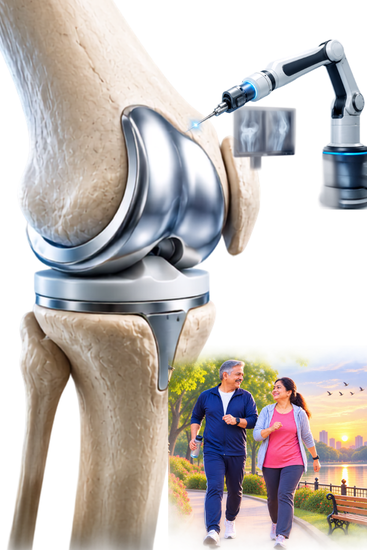
With advances in orthopaedic technology, robotic-assisted knee replacement has become an option for selected patients. This approach combines the experience of an orthopaedic surgeon with computer-assisted planning and robotic technology to help with accurate bone preparation and implant positioning. The robot does not independently perform the operation; the surgeon remains in control throughout the procedure.
What Is Robotic Knee Replacement?
Robotic knee replacement, also called robot-assisted knee arthroplasty, is a form of knee replacement surgery that uses advanced computer technology to help the surgeon plan and perform the procedure.
In a traditional knee replacement, the surgeon uses specialised instruments and measurements to remove damaged bone and place the artificial joint. In robotic-assisted surgery, imaging and computer-assisted planning can help the surgeon create a more detailed plan based on the patient's individual knee anatomy. During surgery, the system can help guide bone preparation and implant positioning.
It is important to understand that robotic knee replacement is still performed by a qualified orthopaedic surgeon. The technology is designed to assist the surgeon, not replace them
Who May Need Knee Replacement Surgery?
Knee replacement is generally considered when knee damage causes persistent pain and difficulty with everyday activities.
Common reasons include:
- Advanced osteoarthritis
- Severe knee joint degeneration
- Rheumatoid arthritis
- Previous knee injury or trauma
- Significant stiffness and reduced mobility
- Persistent pain despite non-surgical treatment
Your orthopaedic surgeon will assess your symptoms, physical examination, X-rays or other imaging, overall health, and response to previous treatments before recommending surgery
Benefits of Robotic Knee Replacement
The potential advantages of robotic-assisted knee replacement can vary from patient to patient.
1. Detailed Surgical Planning
Robotic systems can assist surgeons with detailed pre-operative planning based on the patient's knee anatomy. This can help the surgeon plan bone preparation and implant positioning more precisely.
2. Greater Precision
The technology is designed to support accurate bone cuts and implant alignment. Proper positioning is an important part of knee replacement surgery because it can influence knee function and implant performance.
3. Personalised Approach
Every knee is different. Computer-assisted planning allows the surgical team to work with patient-specific anatomical information rather than relying only on standard measurements.
4. Improved Knee Alignment
Robotic assistance may help the surgeon achieve the planned alignment and positioning of the implant more consistently.
5. Support for Complex Surgical Planning
In selected patients, computer-assisted technology can provide additional information that may help the surgeon manage individual anatomical variations.
However, robotic assistance does not automatically guarantee a faster recovery, better pain relief, or better long-term results for every patient. The suitability and potential benefits depend on factors such as the patient's condition, surgical technique, implant, and rehabilitation
Robotic Knee Replacement vs Traditional Knee Replacement
| Feature | Traditional Knee Replacement |
Robotic-Assisted Knee Replacement |
|---|---|---|
| Surgeon control | Yes | Yes |
| Computer-assisted planning | Limited/varies | Yes |
| Robotic technology | No | Yes |
| Patient-specific planning | Depends on technique | Can be supported by imaging and software |
| Implant positioning assistance | Standard surgical technique | Computer/robotic assistance |
| Recovery | Depends on patient | Depends on patient and rehabilitation |
The key difference is the technology used to assist surgical planning and execution. Both procedures require a skilled surgeon and appropriate post-operative care.
What Happens During Robotic Knee Replacement?
Before surgery, your orthopaedic team evaluates your knee and overall health. Imaging may be used to help create a surgical plan.
During the procedure, the surgeon removes the damaged portions of the knee and prepares the bone surfaces for the artificial components. Robotic or computer-assisted technology may help the surgeon follow the planned alignment and positioning.
The artificial joint components are then placed, and the surgeon checks knee movement and stability before completing the procedure.
The exact technique varies depending on the robotic system, type of knee replacement, and patient's condition.
Robotic Knee Replacement Recovery
Recovery is an important part of successful knee replacement. Surgery is only the beginning; following the rehabilitation plan is essential.
First Few Days
Patients are usually encouraged to begin moving the knee and walking with assistance as appropriate. Pain, swelling and stiffness are common during the early recovery period.
A physiotherapist may teach exercises designed to improve:
- Knee movement
- Muscle strength
- Balance
- Walking ability
- Functional independence
First Few Weeks
As healing progresses, patients gradually increase their walking and daily activities. Regular physiotherapy and home exercises can help restore strength and flexibility.
Your doctor may recommend using a walker, cane or other support temporarily depending on your recovery.
After Several Weeks
Many patients gradually return to more normal daily activities as strength and movement improve. Recovery times vary considerably from person to person.
Long-Term Recovery
After knee replacement, many people can return to everyday activities with less pain and improved mobility. However, high-impact activities may not be recommended, and patients should follow their surgeon's advice regarding exercise and sports.
Tips for a Smooth Recovery After Knee Replacement
Following your surgeon's instructions can make a major difference during recovery.
Take prescribed medicines as directed, attend physiotherapy sessions, perform your recommended exercises, keep the surgical area clean and protected, and gradually increase activity according to medical advice.
Maintaining a healthy body weight can also help reduce stress on the new joint.
Do not try to increase exercise intensity too quickly. Recovery should be gradual and supervised by your healthcare team.
Are There Risks of Robotic Knee Replacement?
Like any major surgery, knee replacement has potential risks. These can include infection, blood clots, bleeding, stiffness, persistent pain, implant-related problems, or other complications.
Robotic assistance does not eliminate these risks. Patient selection, surgeon experience, appropriate surgical technique, and post-operative care remain important factors in achieving good outcomes.
When Should You See an Orthopaedic Specialist?
If you are experiencing persistent knee pain, stiffness, swelling, difficulty walking, or pain that interferes with your daily activities, it is important to consult an experienced orthopaedic specialist. Early evaluation can help identify the cause of your knee problems and determine whether physiotherapy, medication, injections, or knee replacement surgery may be appropriate.
At AIMS Hospital, you can consult experienced orthopaedic specialists, including:
Orthopedic, Joint Replacement & Arthroplasty Surgeon
Orthopedic Surgeon
,
Paediatric Orthopedics
D. Ortho, D.N.B.
These specialists can evaluate knee and joint conditions and recommend an appropriate treatment plan based on your individual needs.
Frequently Asked Questions
1.Is robotic knee replacement better than traditional knee replacement?
Robotic assistance can provide enhanced planning and precision for selected patients, but it is not automatically better for everyone. The best approach depends on your knee condition, anatomy, overall health and your surgeon's assessment.
2.Does a robot perform the knee replacement surgery?
No. The surgeon performs the operation and controls the procedure. Robotic systems are used as technological assistance during planning and surgery.
3.How long does recovery take after knee replacement?
Recovery varies from patient to patient. Walking and rehabilitation usually begin early, while strength, flexibility and confidence with daily activities improve gradually over the following weeks and months.
4.Is robotic knee replacement suitable for everyone?
No. Robotic-assisted surgery may not be necessary or appropriate for every patient. Your orthopaedic surgeon will evaluate your condition and recommend the most suitable treatment.
5.Can I walk after knee replacement surgery?
Patients are commonly encouraged to begin walking with appropriate assistance soon after surgery, depending on their medical condition and the surgeon's rehabilitation protocol.
Conclusion
Robotic Knee Replacement is an advanced approach that combines orthopaedic surgical expertise with computer-assisted and robotic technology. It can support detailed planning, accurate bone preparation and implant positioning in appropriately selected patients.
A successful outcome depends on more than technology. The surgeon's expertise, the patient's overall health, physiotherapy, rehabilitation and adherence to post-operative instructions all play important roles.
If persistent knee pain is limiting your mobility or daily life, consult an experienced orthopaedic specialist to understand whether knee replacement or robotic-assisted knee replacement is right for you.
Looking for expert orthopaedic care in Dombivli? Consult the orthopaedic team at AIMS Hospital Dombivli for personalised evaluation and treatment guidance.

ABOUT US
About AIMSDirector's Message
Vision & Mission
Accreditations
Awards & Accolades
Our Network
Phone Directory
Scan/Click For Location



Designed by Web Creations 2022. All rights reserved.
Leave a Comment